 14 Jul 2026
Breaking the AI Black Box: A Practical Generative Engine Optimization (GEO) Playbook Built on Raw Prompt Logs
Stop optimizing in the dark. Learn how to construct a custom relational data warehouse to decode how LLMs treat your brand, bypass flat-dump reporting limitations with raw prompt-response analysis, and translate hidden AI dialogue into a surgical GEO roadmap that outmaneuvers enterprise legacy giants.

⚡ Key Takeaways
The AI Blindspot: In 2026, legacy SEO tools only track surface-level metrics. Meanwhile, high-priced digital agencies are selling blind "AI Optimization" packages that track a few static keywords instead of analyzing thousands of actual user prompts.
The Flat-Dump Trap: Off-the-shelf platforms provide unrefined lists of text data. They throw an entire, unstructured wall of AI-generated text into a single spreadsheet cell, leaving you with zero structural insights into why you aren't being cited or how to fix it.
Our Proprietary Architecture: We built a custom, 14-sheet relational Data Warehouse (DWH) from scratch, designing the exact row-and-column schema to map the inner logic of Large Language Models (LLMs).
The Highly Curated Dataset: Rather than reporting on thousands of generic, low-value queries, our dataset consists of 77 unique commercial prompts that were strictly pre-filtered for exact relevance to our product and target audience. These 77 prompts mapped to 1,087 raw prompt-response-source entries, representing 100% clean, noise-free, high-value data.
The Playbook: This is not a theoretical study. This is a plug-and-play engineering framework that diagnoses exactly why AI models "friend-zone" your brand and converts raw prompt logs into a highly transparent content roadmap.
Act I: The Snake Oil of "AI Promotion" vs. Pure Generative Engine Optimization (GEO) Intent
The B2B marketing landscape is currently panicking over the "Zero-Click Era." Because traditional organic search traffic is shrinking, agencies have rushed to fill the void with a shiny new buzzword: GEO (Generative Engine Optimization).
If you hire a typical agency to fix your AI visibility today, they will charge you a premium retainer and present a beautiful, empty dashboard. They track high-level keywords, look at basic visibility percentages, and promise they are "optimizing your presence."
It’s an expensive illusion. They are optimizing for search engine keywords, not conversational user intent. Because they cannot show a single direct correlation between their content updates and how an LLM alters its citations, they are essentially throwing darts in a pitch-black room.
To fix your presence in AI engines (ChatGPT, Google Overviews, Perplexity), you have to think less like a traditional marketer and more like a software engineer.
Why Keyword-Stuffing Fails in Generative Search Optimization
When an engineer documents a technical solution on the web, they don’t write an "ultimate guide" packed with marketing fluff. They capture 100% pure intent. They identify a precise operational pain point, strip away the filler, and write a hyper-focused script: “When Error X happens during Y process, use this command to fix it.”
The Engineer’s Approach to AI Content Relevancy
Hundreds of millions of users a week aren't asking ChatGPT for high-level essays; they are looking for immediate, tactical recipes to solve their immediate issues. To get noticed by the bots, your content engine must mirror this exact engineering mindset. But before you can build those recipes, you need to map out the exact landscape of what the AI is saying about your brand when you aren't in the room.
Act II: The Semrush Flat-Dump Trap (Why Legacy SEO Software Fails at GEO Analytics)
If you ask a standard enterprise platform like Semrush for AI tracking data, they will show you a table and point to an "Export" button. When you hit download, you quickly realize you’ve been handed a flat data dump.
[User Prompt] -> [A Massive, Unstructured Paragraph of Text (AI Response)] -> [Total Brands: 52] -> [Total Sources: 9]
The Text Prison of Traditional AI Visibility Dashboards
This layout is a text prison. Because all the critical details are trapped inside a single, unformatted text cell, you cannot run automated filters or look for trends. The software simply tells you that "52 brands were mentioned." It won't tell you if your brand is among them, what your rank is, or which specific competitor URLs the AI is pulling to back up its claims. It forces your team to manually read thousands of lines of dialogue just to find a single actionable insight.
Definition: The Flat-Dump Trap
A failure mode in modern SEO visibility tools where raw LLM responses are exported as unstructured, flat text strings inside a single spreadsheet cell, rendering multi-dimensional relational analysis impossible
Feature Matrix | Legacy SEO Agency "AI Prep" | Our GEO Data Engineering Framework |
Data Granularity | High-level vanity keywords | 1,087 Raw Prompt-Response Logs |
Data Quality | Raw, unguided scraping | Strictly pre-filtered for product relevance |
Analysis Method | Visual Overview tracking | Semantic Parsing & Entity Extraction |
Link Building | Domain Authority outreach | Sniper Outreach to Active AI Sources (Tab 5) |
Core Output | Static PDF Reports | Multi-Dimensional Actionable Roadmap |
Designing a Proprietary Relational Schema for LLM Tracking
We realized that static data dumps wouldn't cut it. So, we designed a custom relational schema from the ground up. We defined every row, engineered every column, and established the logical relationships to break the data out of its text prison and turn it into a multi-dimensional strategy engine.
The Logic:
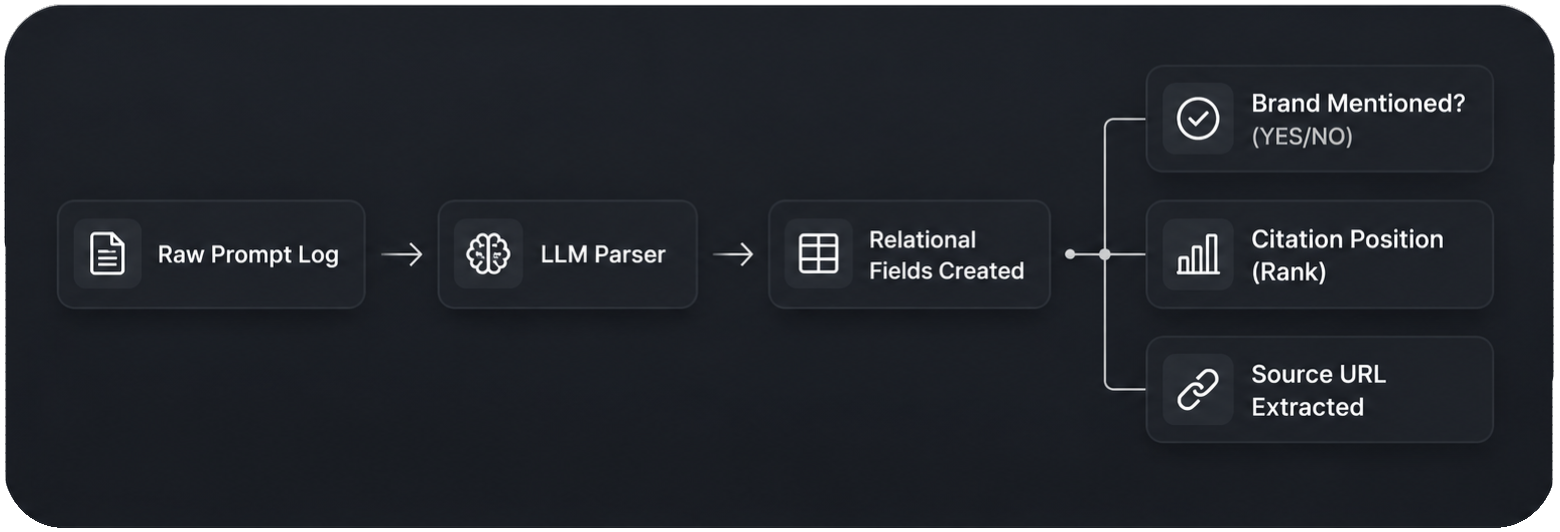
The Practice: main RAW data table
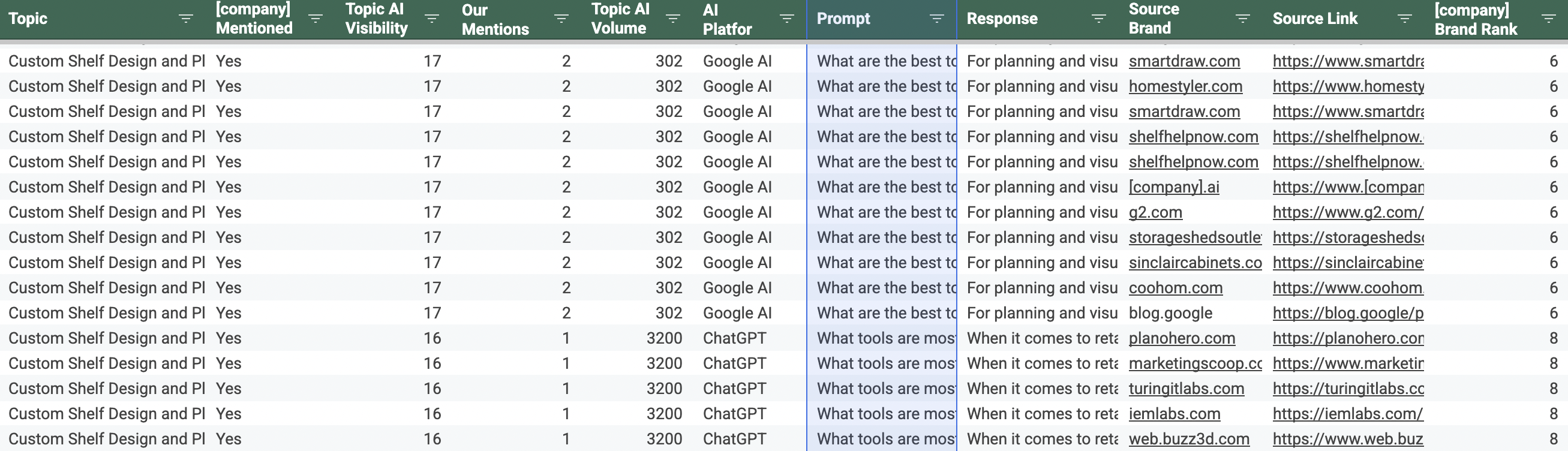
Ground Zero of the GEO Data Warehouse. The master RAW dataset mapping exact prompts, AI outputs, platforms, and cited sources. This single relational foundation fuels all 14 specialized analytical sheets—and scales endlessly as your topical footprint grows.
Act III: Inside the GEO Data Warehouse (The 14-Sheet AI Search Visibility Blueprint)
Instead of a single, chaotic sheet, our proprietary framework breaks the data down into 14 interconnected tabs designed to answer specific operational questions.
Note on Data Curation: While legacy SEO tools flood your reports with thousands of irrelevant "question" keywords, we ran a ruthless relevance filter beforehand. We isolated 77 core prompts that carry immediate commercial intent for our product category. By mapping these to every cited link, we generated a noise-free database of 1,087 raw relational entries. Every single data point in this warehouse matters.
The 14-Sheet DWH Architecture: Blueprint & Business Questions Answered
To turn chaotic AI conversations into a predictable growth pipeline, our Data Warehouse categorizes raw logs across 14 specialized, interconnected sheets grouped into 4 functional modules:
Sheet # | Sheet Name | Core Schema / Data Tracked | Strategic Business Question Answered |
MODULE 1 | Data Ingestion & Taxonomy | ||
Tab 1 | Master RAW Ledger | Prompt x AI Answer x Cited Domain x Rank | What is the baseline ground-truth response for every prompt across ChatGPT and Google AI? |
Tab 2 | Product Topic Clusters | Macro-Topics x Intent Categories x AI Volume | Which core industry categories drive the highest commercial conversation volume in AI search? |
Tab 3 | Prompts Registry | Unique User Prompts x Intent Filters x Platform | How do our target buyers actually phrase their pain points when asking AI models for solutions? |
MODULE 2 | Brand Visibility & Gap Analysis | ||
Tab 4 | The "Friend-Zone" Matrix |
| Where does the LLM know our brand exists, but fails to cite our website as a reference source? |
Tab 5 | Cited Brand Pages | Target Domain URLs x Citation Count x Rank | Which specific landing pages on our domain are actively winning citations, and which are completely invisible? |
Tab 6 | Topic Authority Scorecard | Category x Brand Mention Share x Tier | In which product niches does the AI perceive us as a market leader versus a weak candidate? |
MODULE 3 | Competitive & Source Intelligence | ||
Tab 7 | Sniper Outreach Map | External Domains x Citation Frequency x Prompts | Which specific third-party blogs, forums, and directories does the AI trust as its ultimate source of truth? |
Tab 8 | Granular URL Hit-List | Third-Party URLs x AI Citation Density | Where exactly should we place PR, sponsored content, or backlinks to immediately influence AI output loops? |
Tab 9 | Competitors Master List | Rival Domains x Product Category Mappings | Who is officially recognized by the LLMs as our direct category competitor? |
Tab 10 | Competitor Content Footprint | Rival Domain URLs x Citation Volume | Which specific pages from our rivals are driving their AI dominance, and what structure are they using? |
Tab 11 | LLM Competitor Radar | Brand x Topic x AI Platform Split | Where are our rivals programmatically blind (e.g., strong in Google AI Overviews, but absent in ChatGPT)? |
Tab 12 | Engine Dissection Matrix | ChatGPT vs. Google AI Overviews Variance | How differently do standalone models (OpenAI) treat our category compared to live-indexed models (Google)? |
MODULE 4 | Executive Scorecards & Benchmarks | ||
Tab 13 | AI Competitive Leaderboard (US) | Brand x Mentions x Sources x Est. Share (US) | What is our true AI Share-of-Voice against legacy giants inside the US market? |
Tab 14 | Global Leaderboard (Worldwide) | Global Brand Footprint x Total Audience Share | What is our total global market share inside the AI ecosystem, and how fast are we closing the gap? |
1. The Master Ledger (Topics and Prompts)
The Schema: A centralized database mapping macro-industry topics to specific user prompts, raw textual AI outputs, the designated engine (ChatGPT vs. Google AI), and the exact source URLs cited.
The Actionable Value: Your single source of truth. It allows you to search across your entire industry cluster to find structural patterns in how different models phrase their recommendations.
2. Tab 2 — The GEO "Friend Zone" Matrix (Mentioned but Not a Source)
The Schema: Rows filter for prompts where the AI text explicitly names your brand as a recommended solution, but the columns reveal that your domain is completely missing from the "Sources" citation box below.
Definition: The "Friend-Zone" Matrix
An analytical framework tracking high-authority search queries where an LLM explicitly recommends your brand in its text output but fails to cite your domain in its reference links.
The Practical Use Case: This sheet identifies your absolute lowest-hanging fruit. Out of our 77 unique, highly relevant commercial prompts, 39 instances fell directly into the "Friend Zone" (50.6%). This proves that the underlying language model already has our brand encoded in its core weights (it knows we exist), but our target landing page content lacks the clear, structured data fragments required for the real-time search indexer to grab our link.
The Fix: You don't need to build brand awareness here. You simply take this list and rewrite the target pages to remove corporate fluff, adding high-density Q&A blocks, tables, and clear definitions that match the AI's exact linguistic intent.
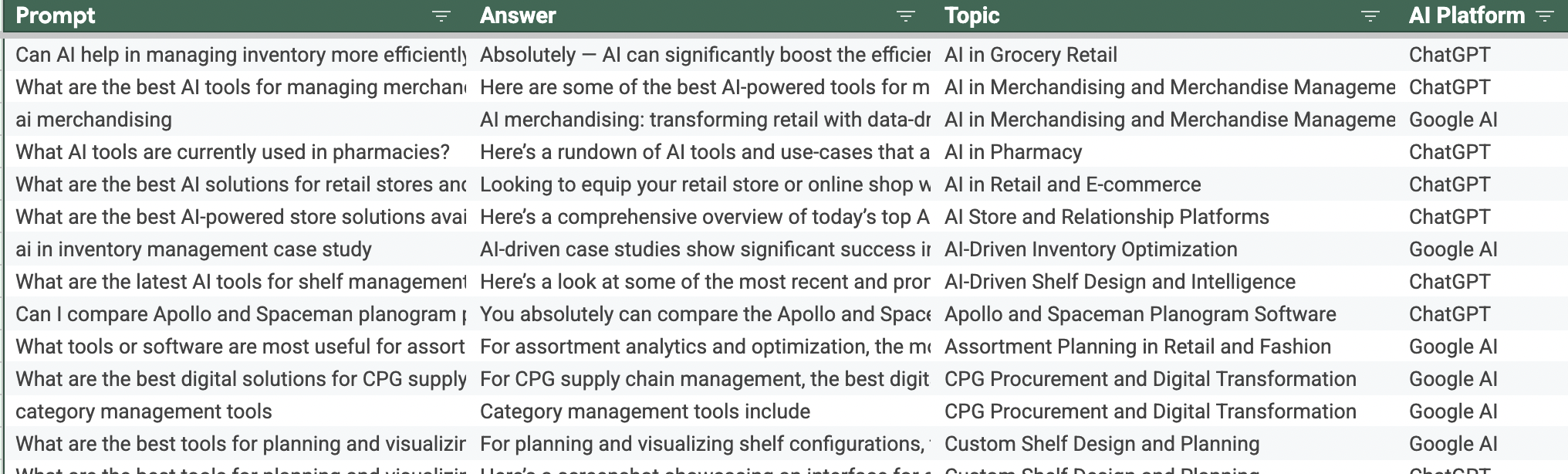
The Prompt-Response Mapping Layer. Mapping unique commercial queries directly to generated AI answers, topic clusters, and LLM platforms (ChatGPT vs. Google AI) to identify linguistic patterns.
3. Tab 3 — The Sniper Outreach Map (Reverse-Engineering AI Citations)
The Schema: Rows list third-party URLs and domains, sorted and aggregated by the exact frequency with which AI models cite them across your target topic clusters.
The Practical Use Case: This completely transforms your backlink and PR strategy. Instead of blindly buying links on high-Domain Authority blogs, you look at this table to see which specific niche directories, forums, or old articles the AI already trusts as its source of truth. In our audit of 1,077 total external citations, we mapped the exact high-frequency nodes. We target those exact URLs for sponsored placements or content partnerships. If the AI already trusts that specific page, any update you insert there will be absorbed into the AI's response loop during its next crawl cycle.
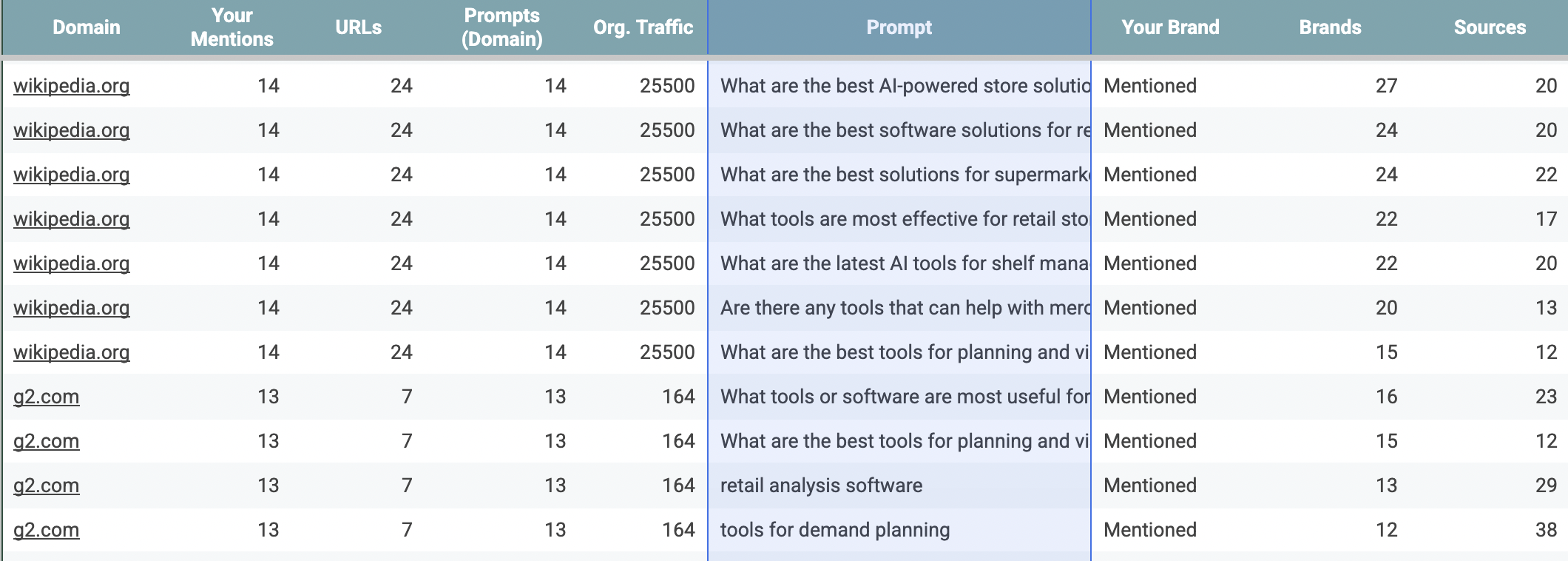
Domain-Level Citation & Prompt Attribution Matrix. Cross-referencing domain citation frequencies with user prompts and brand mentions to evaluate where AI models pull foundational data.
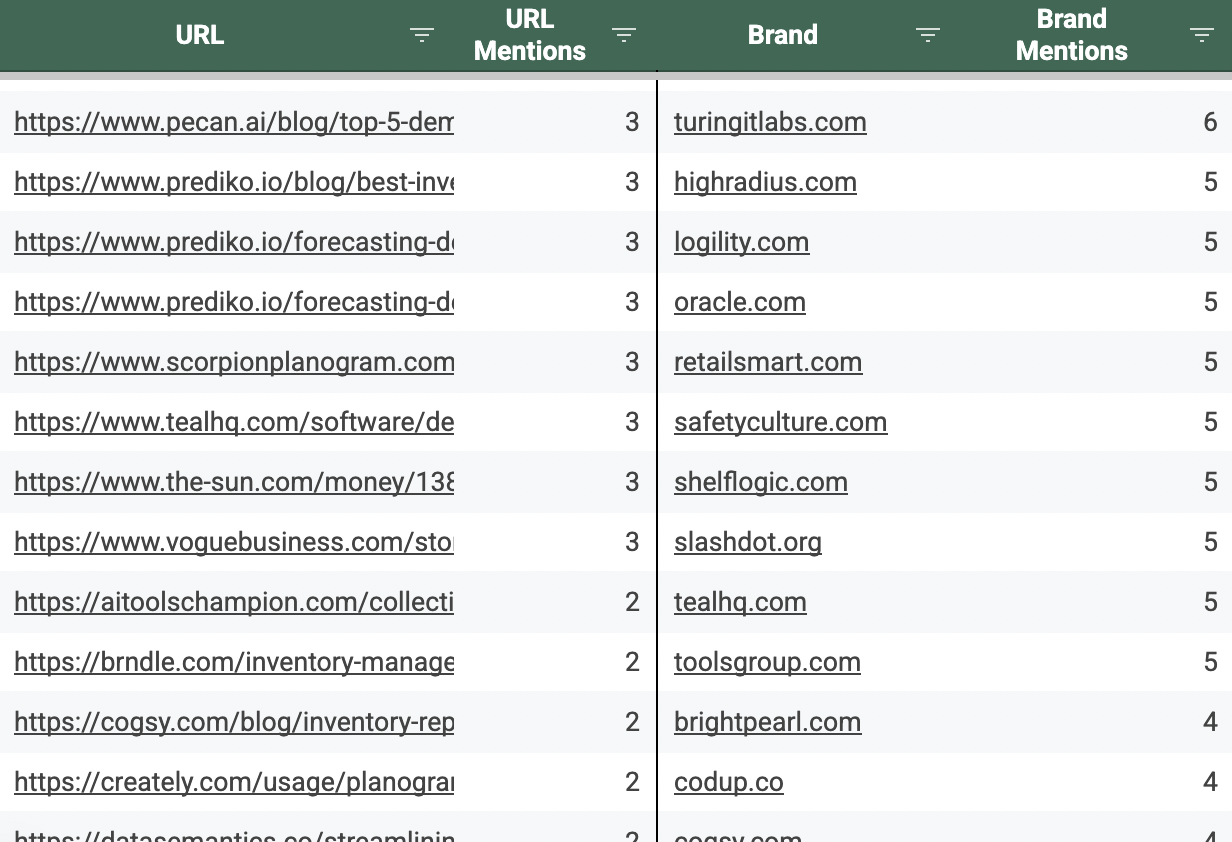
URL-Level Citation Density & Brand Frequency. Isolating specific high-performing blog posts and industry domains that LLMs repeatedly cite, replacing broad link-building with precision AI outreach.
4. Tab 4 — The LLM Competitor Radar (ChatGPT vs. Google AI Overviews Matrix)
The Schema: A multi-dimensional grid (Tab 8) that cross-references
Competitor BrandxTopic ClusterxAI Platform(ChatGPT vs. Google AI) to map out exactly who owns which conversation.The Practical Use Case: Competitors are not a monolith. This radar shows you exactly where your rivals are programmatically blind. For instance, you might discover that a dominant enterprise competitor completely owns Google Overviews for a specific topic due to their legacy domain weight, but is entirely absent from ChatGPT because they lack tactical "how-to" documentation. This allows you to deploy your content resources with sniper-like precision into high-value gaps where the competition isn't looking.
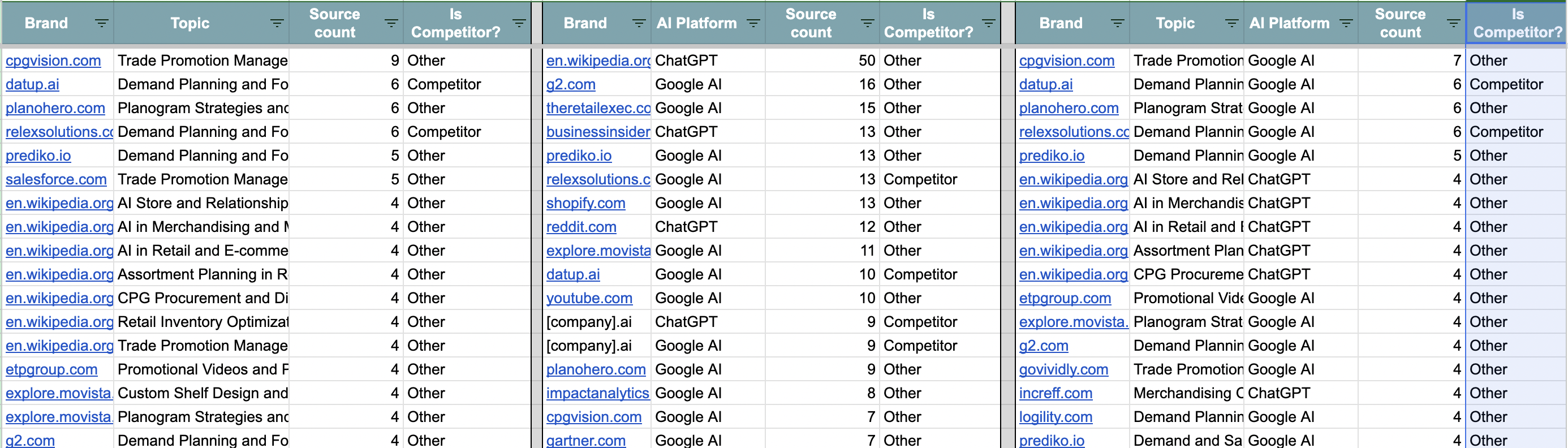
The LLM Competitor Radar Matrix. A multi-dimensional view cross-referencing Brand x Topic x AI Platform to pinpoint exactly where enterprise rivals dominate versus where they are programmatically blind across ChatGPT and Google AI.
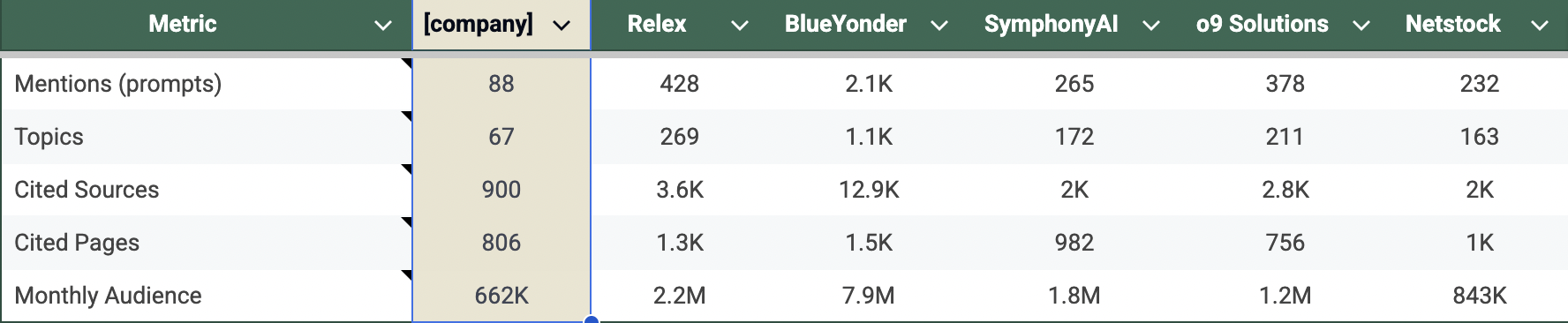
Macro Share-of-Voice Benchmark. Comparing total organic AI footprint against legacy dinosaurs to measure true market share, cited page density, and global citation authority inside the LLM ecosystem.
5. Tab 9 — Brand Topic Authority Scorecard
The Schema: An automated tracking table that aggregates how effectively the AI associates your brand with specific product categories, assigning an authority tier based on mention frequency.
Here is a live look at how the warehouse structures this data to build a tactical roadmap:
Core Industry Topic | AI Engine Mentions | Current AI Perception & Alignment | GEO Action Authority Tier |
Merchandise Planning | 4 | Associated with AI-driven planning & automation | Strong Tier (Protect & Anchor) |
Demand Forecasting | 3 | Linked steadily to predictive forecasting models | Strong Tier (Protect & Anchor) |
Shelf Intelligence / Planograms | 3 | Recognized for automation & visual layout | Strong Tier (Protect & Anchor) |
Retail Replenishment | 3 | Defined as an optimization engine for stock | Strong Tier (Protect & Anchor) |
Merchandising Management | 2 | Seen occasionally; lacks deep pricing context | Scale-up Candidate (Add Core Pillars) |
Planogram Strategies | 2 | Transitional visibility between layout & planning | Scale-up Candidate (Add Core Pillars) |
Supply Chain AI Solutions | 1 | Weak association; enterprise rivals dominate | Critical Gap (Deploy Prompt-Led Hub) |
Trade Promotion Management | 0 | Completely invisible to the models | Critical Gap (Deploy Prompt-Led Hub) |
6. Tabs 13 & 14 — The Ultimate Generative Search Leaderboard
The Schema: Aggregated tables that stack your brand against all industry rivals across five core metrics: Total AI Mentions, Topic Breadth, Total Cited Sources, Total Unique Pages Cited, and Estimated Monthly AI Audience Share.
The Actionable Value: The definitive chart for your executive board. It strips away standard marketing vanity metrics (like impression counts) and shows your true market share inside the global AI ecosystem.
Below is the macro-level Worldwide Leaderboard extracted from our research warehouse, demonstrating the massive content footprint gap between a nimble project and legacy enterprise dinosaurs:
Brand Name | Total Mentions (Prompts) | Topics Covered | Total Cited Sources | Unique Pages Cited | Monthly AI Audience Share |
Our Brand | 88 | 67 | 900 | 806 | 662K |
Enterprise Giant A | 428 | 269 | 3.6K | 1.3K | 2.2M |
Enterprise Giant B | 2.1K | 1.1K | 12.9K | 1.5K | 7.9M |
Enterprise Giant C | 265 | 172 | 2.0K | 982 | 1.8M |
Enterprise Giant D | 378 | 211 | 2.8K | 756 | 1.2M |
Enterprise Giant E | 232 | 163 | 2.0K | 1.0K | 843K |
Act IV: From Data Architecture to GEO Execution (Building Your AI Visibility Roadmap)
This 14-sheet warehouse completely eliminates guesswork. It stops being an academic exercise and becomes a highly transparent "Plug-and-Play" Roadmap for your marketing stack. By looking at the data, your operational next steps become clear as day:
Step 1: Deploying Prompt-Led Content Clusters
Find the high-volume commercial prompts where you are currently invisible. Turn that exact user query into the literal H1 header of a new page, and write the response with the speed and clarity of an engineer solving a bug. Give the LLM an "AI-ready paragraph" it can easily extract without wasting tokens.
Step 2: Liquidating Gated Assets for Bot Indexing
Enterprise giants dominate AI search because their massive historical archives of whitepapers and PDFs are completely open for bot indexing. If your best insights are locked behind an email capture form, you are invisible to the algorithms. Tear down the forms and open your documentation to the web. Turn your gated assets into a public, indexable Academy section.
Step 3: Fragment-Level Content Engineering for Real-Time LLM Snippets
Look at the specific pages that are already winning citations. Notice how Google AI often links directly to a hyper-dense sentence or table via text-anchors (#:~:text=). Replicate that style across your entire site—break your content down into easily extractable informational capsules.
Conclusion: Owning the Context Window
The transition from traditional SEO to Generative Engine Optimization isn't about working harder; it's about altering your entire data perspective. You can continue paying for standard SEO software, hitting the generic "Export" button, and staring at flat columns of unstructured text that fail to drive strategy. Or, you can take control of your data, map the algorithmic landscape through a dedicated warehouse, and systematically build authority exactly where the AI models look for answers.
The rules of search have changed. Build your warehouse, find your gaps, and stop feeding the bots for free.
Frequently Asked Questions
Recommended for you

 Jun 18, 2026
What Kind of Beast is Similarweb? The No-Bullshit Digital Intelligence Guide
Stop scaling in the dark. Learn how to weaponize Similarweb for analysis of competitors, bypass the 2026 data privacy blackout with predictive AI modeling, and translate raw market intelligence into a multi-channel growth engine that chokes out your rivals.
 May 18, 2026
Competitive & Market Intelligence: The Hard-Core Guide to Unmasking Market Winners
Stop scaling in the dark. Learn how to extract raw competitor data from Similarweb, Ahrefs, and Semrush, and translate chaotic market analytics into explicit, high-impact tactical workflows that actually drive business growth in 2026.
 May 5, 2026
Market & Competitor Intelligence 2026: The "No-Bullshit" Guide for Growth Architects
If your competitor research doesn't end with a list of at least 10 high-probability hypotheses and a tactical plan to steal market share, you haven't done research. You’ve done creative writing. In 2026, we don't need more slides; we need more targets.
Be the first to comment!