 5 May 2026
Market & Competitor Intelligence 2026: The "No-Bullshit" Guide for Growth Architects
If your competitor research doesn't end with a list of at least 10 high-probability hypotheses and a tactical plan to steal market share, you haven't done research. You’ve done creative writing. In 2026, we don't need more slides; we need more targets.
Most founders think competitor research is about tracking competitors.
It’s not.
It’s about understanding where the money moves—and where it doesn't. If you’re just watching their social media, you’re a fan. If you’re deconstructing their unit economics, you’re a hunter.
⚡ Key Takeaways
Action over Aesthetics: Research must end with tactical hypotheses, not just visual charts.
Tool Synergy: Combine Similarweb for traffic, Ahrefs for SEO infrastructure, and 6sense for the "dark funnel" de-anonymization.
Efficiency First: Use competitor failures to skip costly mistakes; if they stopped a campaign, they already paid for your lesson.
Market Mapping: Define TAM/SAM not as static numbers, but as dynamic targets based on competitor vulnerabilities.
The Great Research Mirage: Dust, Slides, and No Water
Let’s be honest: most market research is a crime against productivity. Agencies and "consultants" charge five-figure fees to deliver 150-slide PDF mausoleums filled with "industry trends" and generic SWOT analyses. It’s "research for research's sake"—a security blanket for executives who are too afraid to make a move without a colorful chart.
We call this "The Slow Dance of the Dead." While you’re staring at a pie chart of "Global Sentiment," your competitor just sniped your top three keywords and redirected your best referral traffic to their landing page.
In the world of growth architecture, we don't care about "market sentiment" in the abstract. We care about where the money is leaking. If your research doesn't result in a concrete base for tactical action, you’re just window shopping in a ghost town while the real gold is being hauled away.
In the world of growth architecture, we don't care about market sentiment in the abstract. We care about where the gold is buried.
Before we talk about tools, tables, and algorithms, let’s look at the operators who didn’t just survive the market—they raided it.
These aren't just marketing stories; they are tactical operations born from a single, sharp intelligence insight that the giant, bloated leaders were too blind to see. These are the hunts that changed history.
The Art of the Strategic Raid
Most people think research is about filing reports. They’re wrong. It’s about finding the one loose brick that brings down the whole fortress. Look at the men who didn’t just play the game—they changed the rules by seeing what everyone else ignored.
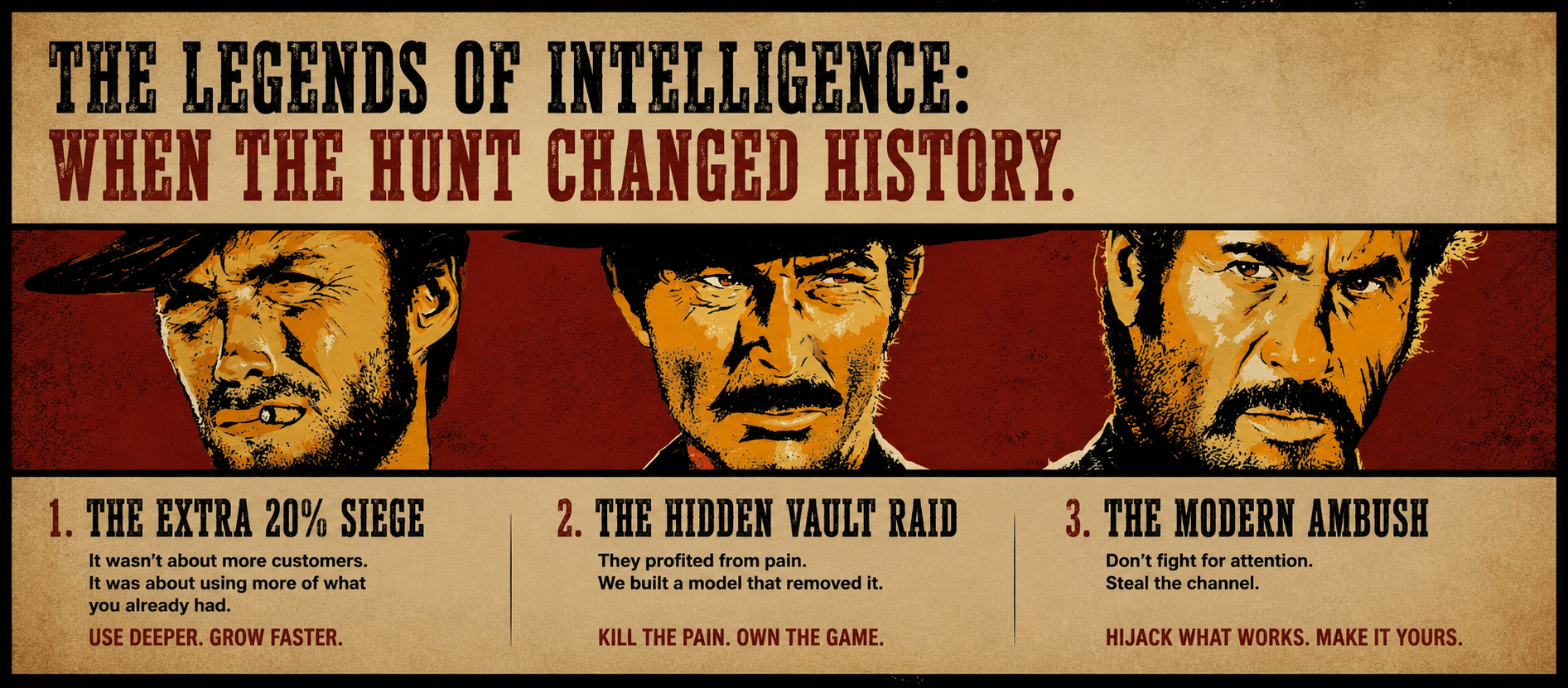
If you think market research is just about filling tables, you’re missing the thrill of the hunt. Throughout history, those who looked deeper—who saw the "Shadow Signals"—didn't just get a market share. They took the whole pot.
1. The "Extra 20%" Siege (The Toothpaste Legend)
For decades, toothpaste brands spent millions trying to acquire new customers. They were fighting for the same "Outlaws" in the desert. Then, a simple research insight changed everything. They didn't look at the competitors; they looked at the User Behavior (The Micro-Intelligence).
The Move: Someone realized that the hole in the tube was small. By simply doubling the diameter of the nozzle, they forced users to use more product per brush.
The Kill: Sales skyrocketed by 20% overnight without a single new customer. It wasn't about "Features"; it was about understanding the consumption cycle better than the consumer themselves.
2. The "Hidden Vault" Raid (The Netflix vs. Blockbuster Standoff)
Blockbuster was the "Sheriff" of the town. They had the buildings, the inventory, and the budget. Netflix was a "Drifter" with a mail-order service. But Netflix did one piece of research that Blockbuster ignored: The Pain-Point Autopsy.
The Signal: Netflix realized that Blockbuster’s entire unit economics relied on "Late Fees"—a feature that 100% of customers hated.
The Attack: Netflix didn't build better stores. They built a subscription model that killed late fees. They attacked the "Status Quo" by removing the friction the leader was too greedy to fix. Blockbuster didn't die because of tech; they died because they were blind to their own customers' resentment.
3. The Modern Ambush: Airbnb vs. Craigslist
In their early days, Airbnb was a tiny project against the giant of Craigslist. Instead of outspending them, they conducted a Technical Raid (The Digital Shadow).
The Intelligence: They realized that all their target hosts were already posting on Craigslist.
The Surgical Strike: They built a bot that automatically cross-posted Airbnb listings to Craigslist with a "Post to Craigslist" button. They hijacked the giant's distribution infrastructure to fuel their own growth. They didn't build a new market; they raided an existing one using superior technical intelligence.
Why These Matter for You:
These weren't "marketing campaigns." They were Tactical Operations born from deep research.
The Nozzle was about Product Depth.
The Late Fees were about Business Model Vulnerability.
The Craigslist bot was about Distribution Hijacking.
The Moral: You don't need a bigger gun if you know exactly where the Sheriff keeps his keys.
The Real Mission: Why We Dig in the Dirt
We don't research to feel smart or to fill up a Google Drive folder. We research to find the "North Star" of the enemy and then build a better telescope.
Eliminate the "Maybe": Most marketing is "spray and pray." We want "one shot, one kill."
Scout the White Space: Where is the "Sheriff" of the niche getting lazy? Where are the leaders overcharging and under-delivering?
The "Mercenary" Advantage: We live by the mantra: "A failed test is still a result." But why spend $50k failing on a test that your competitor already botched two years ago? Let them pay for your education. We’ll just take the degree.
The Intelligence Spectrum: From Perception to the Dark Funnel
Research isn't a monolith. You need to know which weapon to pull from the holster depending on how far the target is:
The Good: Brand Visibility & Real Value.
This is how the market perceives you vs. them. We look for the gap between what they promise on their $100k homepage and what the users actually say in the "saloon" (forums, reviews, social). If their "Premium" positioning is just expensive lipstick on a pig, that's our opening.
The Bad: SEO & Clickstream Intelligence.
This is where we get our hands dirty. Tools like Similarweb and Semrush aren't just for looking at traffic graphs. We use them to track the Clickstream—the actual digital footprints. Where did the user go right before they pulled out their credit card? That site is our next partner. That keyword is our next ambush.
The Zesty: The Heavy Artillery (6sense & Slintel).
For the real bounty hunters, there’s a deeper level. Tools like 6sense (powered by their Slintel acquisition) allow us to de-anonymize the "Dark Funnel." We're talking about identifying exactly which companies are using your competitor’s tech, seeing their contract renewal cycles, and mapping their distribution by geo with terrifying precision. This isn't research; it's a digital raid on their CRM.
The 4 Layers of Your Battlefield
Most teams aim at everyone. Smart teams pick their duel.
Don't just look at the guy selling the same software (or a product, service, or whatever). Look at everyone who steals your customer's attention and budget:
Direct (The Outlaws): Same product, same audience. (e.g., Zoom vs. Google Meet).
Indirect (The Drifters): Different product, same goal. (e.g., Zoom vs. Slack).
Substitutes (The Alternatives): A different way to solve the problem. (e.g., Zoom vs. Business Travel).
No-Solution (The Status Quo): The user does nothing and stays in chaos. Using traffic analysis, we often see that 45% of a market leader’s potential traffic drops off completely—they choose the chaos of 'nothing'. This is your biggest competitor.
The Gravity of Scale: Are You Even in the Same Train?
However, product similarity is only one lens. To build a bulletproof strategy, you must understand that product alignment doesn't always equal competition. You need to look at the market position and the sheer mass of the players involved.
Take Semrush and Surfer SEO as a tactical example. On paper, they both help you with SEO. In reality, they are playing in different galaxies of scale.
When a market leader—let’s assume for the sake of the example—is burning $1M/mo on Meta ads alone, while your total budget is $12k for everything, you aren't 'competing' for the same territory. You are navigating in the shadow of a giant.
It’s not just about the code; it’s about the operational weight. You can’t be a direct competitor to someone whose marketing gravity is 100x stronger than yours.
You are in different orbits.
The Lesson: If you ignore the disparity in scale and budget, you aren't doing research; you’re daydreaming. You don't fight a giant by mimicking his spend or his feature list. You fight him by finding the tactical gaps where his massive size makes him slow to react.
The Amateur’s Grave: Where Data Goes to Die
The Reality Check: If your research doesn't force a decision, it’s not intelligence. It’s a hobby. In 2026, the market doesn't pay for "interesting information." It pays for Targeted Action.
The biggest mistake in research isn't missing a data point—it's Research for the sake of Research. If your analysis doesn't end in a "kill order" for a failing feature or a pivot in your acquisition strategy, you haven't done research. You’ve just performed an expensive autopsy on a living business.
The Echo Chamber (Tunnel Vision): You are so obsessed with tracking your direct rival’s every move that you miss the Substitute eating your lunch. While you’re optimizing your "Email Marketing Tool," your audience just moved to an AI-agent that does the work for them. You’re winning the battle for a feature that no longer matters.
The Copycat Syndrome (Suicidal Mimicry): Cloning features without understanding the "Why." Copying a market leader who is secretly failing is just a faster way to drown. You’re building a "moat" around a sinking ship just because the captain has a famous name.
Distribution Blindness (The Product Trap): You’ve deconstructed their product to the last line of code, but you have no idea how they actually get it into users' hands. A mediocre product with a $1M/mo distribution engine will kill a "perfect" product that no one can find, every single time.
The Librarian’s Curse (The Final Sin): This is the deadliest error. It’s when the research ends in a "pretty" PDF that everyone praises but no one uses. You spent 40 hours collecting data, but zero hours deciding what to change tomorrow.
The Upart Blueprint: A Methodology for the Bold
Don't just stare at the data. Use it to build an empire. Here is how you architect a real market audit:
1. Defining the Methodology: Pick Your Poison
Before you open a single tool, decide how you are measuring success. Are we looking for quick-win SEO gaps to boost this month's ROI, or are we deconstructing a long-cycle B2B sales engine for 2027? Your methodology is your filter; without it, you're just a man lost in the desert with a map written in a language you don't speak.
2. Market Criteria: Choose Your Battleground
We don't look at everyone. We choose markets based on Strategic Fit and Scalability. We select competitors not just because they are big, but because they are vulnerable or innovative. If they aren't a threat or a teacher, they don't deserve our time.
3. The Landscape: TAM, SAM, and the Three Amigos
Direct Competitors (The Outlaws): Those fighting for the same dollar, right now.
Indirect Competitors (The Drifters): Those solving the same problem but with a different tool.
Market Leaders (The Sheriffs): The stagnant giants. We map our position to see our SAM (Serviceable Addressable Market). If the Sheriff is getting fat and slow, your SAM just got a whole lot bigger.
4. Competitor Metrics: The Autopsy
We don't just look at what they do. We look at what they stopped doing.
Did they abandon a specific GEO? That’s your new territory.
Is their "Keyword Gap" widening? That’s your content plan.
Is their "Brand Interest" dropping while their "Paid Spend" increases? They are bleeding out. Finish them.
A competitor's abandoned campaign is the most honest feedback you will ever get for free.
5. From Research to Action: The Foundation of Strategy
This is where the "Bad and the Ugly" separate from the "Pros." Your research must become the Nerve Center of your marketing.
Don't say: "They are strong in the US."
Do say: "They have a 20% conversion gap on mobile in Texas. We’re launching a localized campaign to steal those leads by Friday."
The Specialist’s Arsenal: Choosing Your Weapon
It’s not about owning every revolver in the desert. It’s about knowing exactly which bullet terminates the competitor’s strategy
To get a true 360-degree view, you need to understand the specialty of every weapon in your holster. Relying on one tool is like bringing a knife to a cannon fight. Here’s how we split the labor:
Semrush (The Market Architect): We have to give credit where it’s due—their Traffic & Market Intelligence suite (formerly .Trends) is a game-changer. By leveraging massive clickstream datasets, they’ve moved beyond simple SEO to provide a high-definition view of market dynamics. It is currently the king of search intent and Audience Overlap, allowing you to see exactly where your territory ends and the enemy's begins.
Similarweb (The Radar): Unmatched in Referral Analytics and overall category behavior. If you want to know which "watering holes" (websites) your customers visit before they buy, this is your primary radar for mapping the digital ecosystem.
Ahrefs (The Engineer): The master of Backlink Infrastructure. Use it to deconstruct the competitor's authority and see exactly which "alliances" (links) they are building to protect their SEO fortress.
The combination gives you the full picture. It’s like a puzzle where the pieces come from different makers, but when they snap together, you finally see the face of the man you’re hunting.
The War Map – Engineering Your Conquest
Now, you shouldn't just take my word for it. I’ve spent enough time criticizing the 'mirage' and the 150-slide graveyards of others. In this game, trust is a luxury we can’t afford—but data? Data is the only thing that won’t jam when you need it most. So, let’s level the playing field. The music has stopped, and it's time to show you what a 'grown-up' analysis actually looks like. I have the map.
Now we start.
The quality of your strategic decisions is directly proportional to the depth of your data. If you fill this table with superficial guesses, you’ll get nothing but another mirage. But if you arm yourself with the industry’s heavy artillery—Similarweb, Ahrefs, and specifically Semrush—you gain a mathematically precise scope for market domination.
Strategic Filter | Your Project | Competitor A (The Outlaw) | Competitor B (The Sheriff) |
ICP | Who is their real hero? | Early Adopters / Solopreneurs | Enterprise / Corporate IT |
Value Prop | Why do they pay? | Speed, Agility & Low Cost | Reliability, Compliance & Trust |
Pricing | How do they charge? | Freemium + $19/mo tier | Custom Quote (starts at $15k/yr) |
Growth Channel | Where is the gold? | Product-Led Growth (Viral loops) | Sales-Led Growth (Cold outreach) |
Geos (All + Top) | Where do they fight? | Global (Top: US 40%, UK 15%, DE 10%) | LATAM (Top: BR 50%, MX 30%) |
Market Share | How big is their slice? | 2.5% (Growing fast) | 42% (Stagnant or declining) |
Marketing Channels | Traffic distribution? | Organic (45%), Direct (35%), Paid (20%) | Paid Search (60%), Display (25%), Direct (15%) |
Top Traffic Source | Their primary goldmine | Google SEO (Non-brand keywords) | Paid Search (Competitor brand terms) |
Traffic Types | Brand vs. Non-Brand / Device | Non-Brand (75%), Desktop (80%) | Brand Paid (70%), Mobile (65%) |
A pro tip: Never rely on a single source of truth. The real magic happens when you aggregate data. Cross-referencing Semrush’s massive clickstream datasets with Similarweb’s market share estimates allows you to eliminate "blind spots" and verify every signal. When three different engines show you the same competitor vulnerability, you don't just have a hunch—you have a target.
The Anatomy of Victory: What Depth Actually Gives You
When you reach this level of granularity, the "marketing on a hunch" fog evaporates. You are left with cold, hard facts that transform your research into a tactical execution plan.
1. A Map of the Actual Battlefield (Not the PR Version)
You finally see the real leaders, the laggards, and the hidden "predators" quietly siphoning your traffic.
The Insight: You might think your rival is a multi-billion dollar giant. But clickstream analysis reveals that 40% of your potential leads are actually bouncing to a small, nimble Chrome extension that solves one specific pain point faster. Your sights should be set on the sniper, not the giant.
2. Victory as a Mathematical Equation
The market stops being an abstract cloud and becomes a tangible pie (Market Share). Winning is no longer a "feeling"; it's a calculated value of the percentage points you can seize.
The Insight: Instead of the vague goal of "getting more sales," you get a roadmap: "The leader lost 4% share in Brazil last quarter due to a drop in organic reach. We will launch a localized aggressive SEO campaign in Brazil to intercept that 4% immediately."
3. Surgical Separation of Tactics and Strategy
You stop reacting and start orchestrating. You know exactly which move brings cash tomorrow (Tactics) and which move builds a "moat" for years (Strategy).
Tactical Move: Intercepting a competitor’s branded search traffic via PPC during their major service outage or a wave of negative PR.
Strategic Move: Building your own proprietary media asset or a free SEO tool in a niche where competitors have zero organic presence.
Example: Intercepting a competitor’s branded search traffic via PPC during their major service outage is a Tactic. Building a proprietary media asset where they have zero presence is a Strategy.
The Reality Check:
If your competitor owns SEO, you don’t win with Features. You win by attacking a channel they are ignoring.
If they dominate via PLG (Product-Led Growth), you don’t win with a Sales Team. You win by finding a segment that requires "High-Touch" service which their automated machine can't provide.
4. Reading "Shadow Signals" and Anomalies
This is the richest layer of data. You begin to see the enemy's hidden moves and learn from their failures for free.
The "Halt Sales" Signal: You notice via Similarweb that a competitor suddenly cut off traffic to a specific service landing page. An amateur thinks, "Great, they left the niche, let’s jump in!" A professional realizes, "They burned $50k on that funnel, realized the LTV/CAC was a nightmare, and quietly shut it down." Your competitor just paid for your education. You avoid that swamp entirely.
5. Identifying Channel Vulnerability
You see what "fuel" is powering the competitor's engine—and you can cut off their oxygen.
The Insight: If 70% of a competitor's traffic is "Brand Paid," they are addicted to expensive ads because their organic brand is weak. The moment the CPC spikes or their budget is trimmed, their traffic collapses. Your move? Dominate the "Non-Brand" SEO space to own the top of the funnel permanently while they burn cash in the auction.
The Final Verdict
Most people don’t do competitor research. They just organize information about companies they don’t understand. They build libraries of screenshots while their rivals build empires.
If your research doesn't force you to change your roadmap, kill a feature, or pivot your positioning—it wasn't research. It was a hobby.
In 2026, the market doesn't reward librarians. It rewards architects who know exactly where to place the charges to bring the old building down.
The music has stopped. Go dig.
Frequently Asked Questions
Chapters in this Guide

 May 18, 2026
Competitive & Market Intelligence: The Hard-Core Guide to Unmasking Market Winners
Stop scaling in the dark. Learn how to extract raw competitor data from Similarweb, Ahrefs, and Semrush, and translate chaotic market analytics into explicit, high-impact tactical workflows that actually drive business growth in 2026.
Software mentioned in this article
Post a comment
Comments
Recent News
Featured Software
Be the first to comment!