 18 May 2026
Competitive & Market Intelligence: The Hard-Core Guide to Unmasking Market Winners
Stop scaling in the dark. Learn how to extract raw competitor data from Similarweb, Ahrefs, and Semrush, and translate chaotic market analytics into explicit, high-impact tactical workflows that actually drive business growth in 2026.

Take a look at the featured image of this guide. If you are launching performance campaigns or scaling a B2B SaaS without a ruthless competitive intelligence framework, you are exactly like Jimmy McGill on his knees in the middle of the New Mexico desert. You are completely exposed, tied up by your own lack of data, and facing a market that acts like a volatile cartel leader ready to execute your budget. It’s time to stop gambling. It's time to build your data-driven defense. Let’s look at how we deconstruct markets step-by-step.
⚡ Key Takeaways
CI is Reverse-Engineering, Not Aesthetic Observation: True competitive intelligence is the systematic deconstruction of a rival's operational footprint—mapping traffic loops, auditing media spend, and exposing structural gaps. If your audit ends with "they have a clean UX," you are passively observing, driving zero ROI.
Segment Before You Extract: Avoid data drowning by categorizing your market landscape into three distinct buckets: Direct Competitors (same problem, same audience), Indirect Competitors (same problem, different categories), and North Stars (global giants tracked strictly for infrastructure and scaling blueprints).
Centralize and Extract the Raw Blitz: Never analyze data across 20 open browser tabs. Merge your traffic mixes, keyword gaps, and sudden GEO spikes into a single, unified master matrix. A sudden 30% regional traffic spike is the ultimate early-warning indicator that a competitor is validating a new paid acquisition test.
Data is Useless Without Surgical Translation: The diamond value of analytics lies in converting raw numbers into explicit team commands. If a matrix reveals a market leader ignoring a channel or ranking for 45 unexploited commercial terms, stop your current routine and pivot your sprints to hijack those specific vulnerabilities immediately.
Treat Competitors as Your Fully-Funded R&D Lab: Let legacy brands and aggressive challengers burn their cash validating new marketing channels, regional funnels, and onboarding hooks. Your job is to analyze their execution, isolate their audience's friction fatigue, and engineer the precise loophole to poach their market share.
What Competitive & Market Intelligence Actually Is (And the Cost of Blindness)
Let’s establish a baseline: true market intelligence is not an aesthetic audit. It is not about looking at a competitor's homepage, noting their brand colors, and declaring, "Hey, they have a clean UX." That is passive observation, and it drives zero ROI.
Competitive Intelligence is the systematic, data-driven reverse-engineering of any rival’s operational footprint. It is the practice of mapping out their traffic loops, identifying their highest-converting customer acquisition channels, auditing their media spend, and exposing the structural gaps in their product or positioning.
The True Cost of Data Blindness:
The Sunk Cost Trap: Pouring thousands of dollars into Facebook or Google Ads in a specific geography, completely unaware that your top three competitors have already tested that channel in that market, failed, and shifted 80% of their budget to targeted referral partnerships.
The "Invisible" Competitor: Focusing exclusively on the legacy brand in your space while an agile, product-led SaaS platform quietly steals your organic search share of voice through advanced content clustering.
Funnel Friction: Optimizing your checkout pages based on general aesthetic best practices instead of reverse-engineering the exact high-converting workflows that market leaders have spent hundreds of thousands of dollars split-testing.
Digital Market Research Methodologies: Beyond the Standard SWOT
Traditional business schools still teach the 4Ps and standard SWOT analysis. In a fast-moving digital economy, a static SWOT report is outdated the moment it's saved to Google Drive. To architect a dominant growth engine, you need an integrated, multi-layered methodology:
The 4 Layers of Modern Digital Intelligence:
Infrastructure & Stack Intelligence: Identifying the core technology powering a competitor. Are they on a legacy server environment that causes latency, or are they utilizing high-performance LiteSpeed servers and edge networks? What tracking scripts, CRM routers, or payment gateways are they deploying?
Acquisition & Traffic Topology: A surgical breakdown of where their attention comes from. This requires looking at cross-channel distribution—mapping out the exact ratios between Direct, Referral, Organic Search, Paid Search, Social, and Email traffic over a rolling 12-to-15-month historical window.
Semantic & Visibility Audit: Calculating a competitor’s exact Share of Voice (SoV) within search engines. This means mapping their ranking footprint, identifying their high-intent "money keywords," and isolating the "Keyword Gap"—the high-value terms they are converting traffic on that you aren't even targeting.
Funnel & Conversion Auditing: Moving past top-of-funnel traffic. This layer analyzes competitor behavior through user flows: deconstructing their ad creatives, identifying their primary landing page angles, and tracking down user paths to map out the exact transaction and checkout loops that drive their revenue.
The Strategic Value: Business Use Cases That Changed Market History
When done right, market intelligence doesn't just protect your current market share—it provides the strategic roadmap for disruption. It answers the specific "job" your business needs done: How do we scale predictably without wasting capital?
Historical Blueprints of Strategic Data Utilization:
The Underdog Pivot (Airbnb vs. Craigslist): In its early days, Airbnb didn't just build a better platform; they analyzed where their target audience was already hanging out. By reverse-engineering Craigslist’s underlying architecture, they created an automated loop that allowed hosts to cross-post to Craigslist with one click. They poached their competitor’s traffic infrastructure and used it to fuel their own exponential growth loop.
The SEO Counter-Attack (Canva vs. Legacy Software): Canva didn't compete head-on for high-level terms like "graphic design software." Instead, they audited the exact operational pain points of everyday users. They discovered a massive volume of low-competition, high-intent searches for specific, long-tail terms like "how to make a resume template" or "design a restaurant menu online." They engineered thousands of programmatic landing pages targeting these exact keyword gaps, bypassing legacy giants completely and capturing millions of high-converting users globally.
Execution Roadmap: Step-by-Step Competitive Extraction
This is where we move from theory to heavy machinery. This step-by-step framework mirrors the exact competitive tracking workflows used by world-class growth architects.
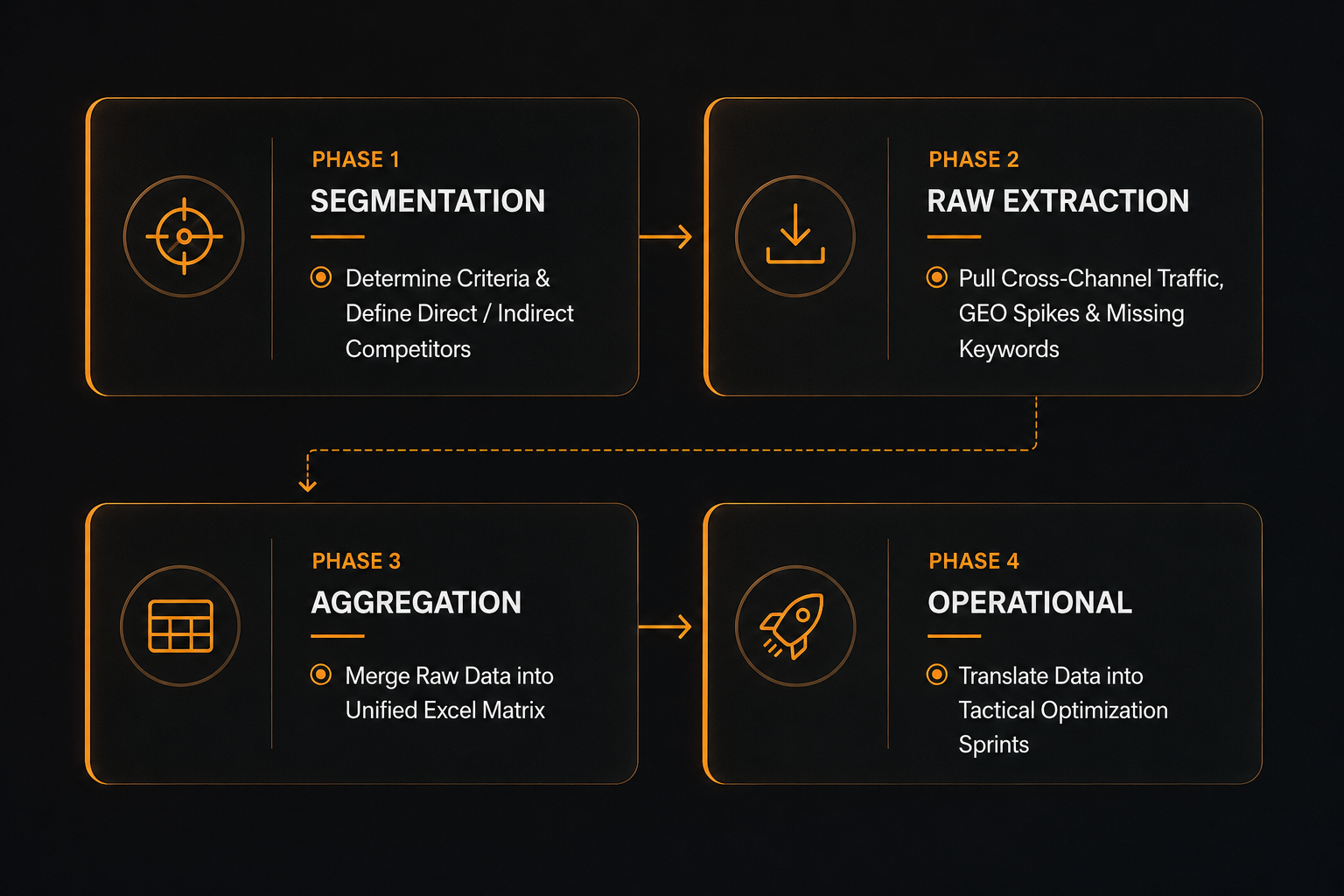
Step 1: Define Your Criteria & Segment the Battlefield
You cannot track everyone. You must segment your market landscape into three distinct categories to avoid data drowning:
Direct Competitors: Brands solving the exact same problem for the exact same target audience with a similar business model. (e.g., if you sell high-performance cloud servers in Germany, your direct competitors are other specialized regional cloud hosts).
Indirect Competitors: Brands that solve the same problem but via a completely different product category or model. (e.g., Shared hosting providers or absolute enterprise-grade bare-metal data centers).
Market Leaders / North Stars: The global giants. You might not compete with them for the same customer tomorrow, but you track them exclusively to reverse-engineer their advanced marketing infrastructure, structural funnel updates, and programmatic scaling plays.
Step 2: The Raw Data Extraction Blitz
Open your operational toolkit (Similarweb, Semrush, Ahrefs, Google Search Console). You need to extract unmasked, raw data across these core metrics:
The Traffic Mix Matrix: Pull the exact percentage split of acquisition channels over the last 12 months. Is their primary engine organic search, or are they heavily addicted to expensive Google PPC spend?
GEO Distribution Details: Break down traffic by country. Look for sudden regional spikes. If a competitor suddenly registers a 30% month-over-month traffic increase from Germany or Ukraine, they are actively scaling a paid acquisition test or localized SEO campaign in that market.
The Missing Keyword Deep-Dive: Run a comprehensive Keyword Gap analysis. Extract the exact high-intent search terms where your top 3 competitors rank on page 1 of Google, but your site is completely unranked.
Paid Media Creative Scraping: Use ad intelligence tools to extract active paid ad copies, display banners, and the specific landing pages they point to. Note the conversion angles: are they selling on price, speed, or security?
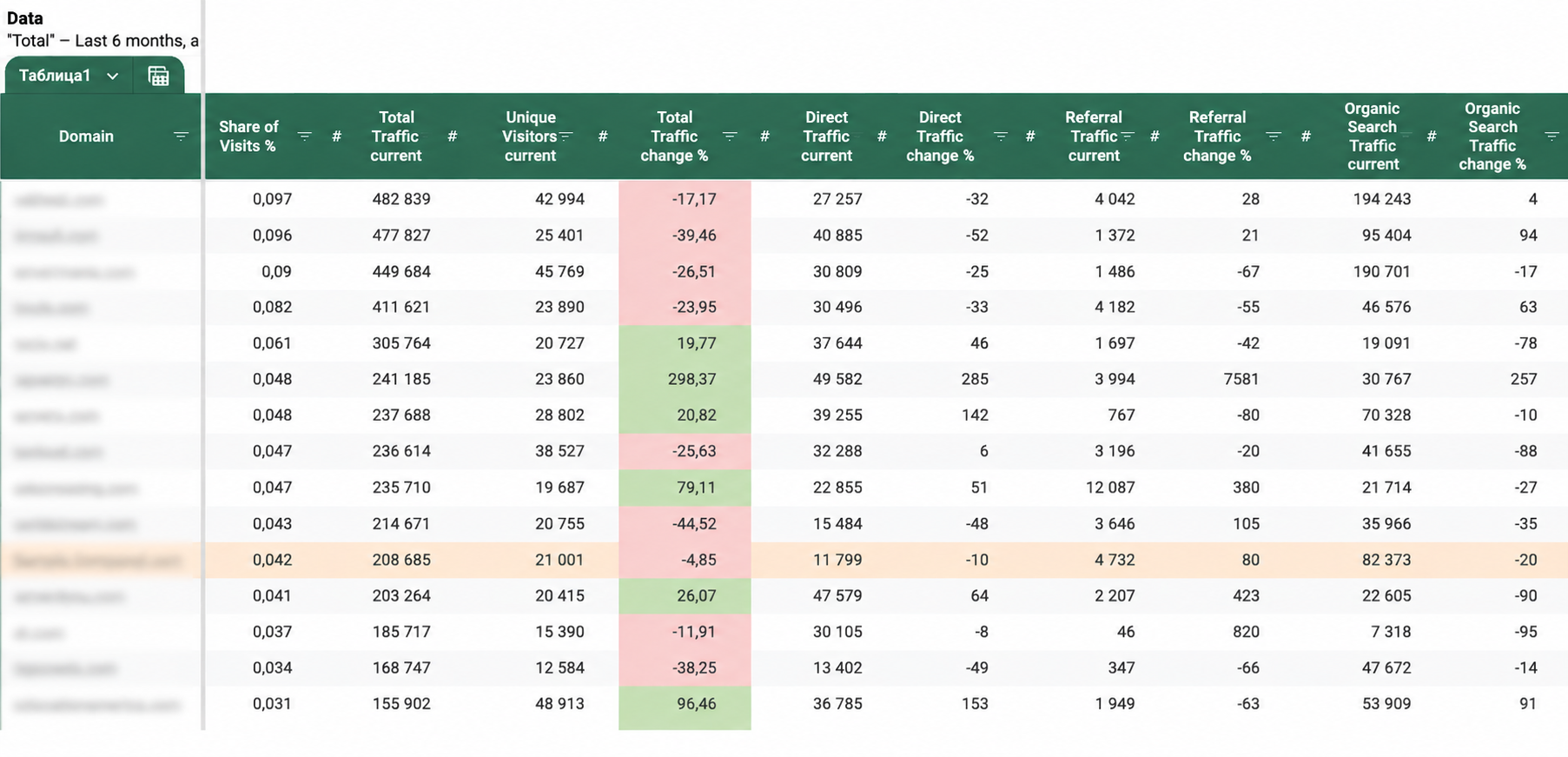
Step 3: Centralized Data Aggregation
Never analyze data across multiple open browser tabs. Take all your raw CSV and Excel exports and merge them into a single, unified master matrix.
Your master sheet should contain centralized tabs for:
Competitors Overview: Core business metrics, estimated monthly volume, primary GEOs, and pricing tiers.
Don't waste hours formatting cells, mapping cohorts, and configuring data hierarchies from scratch. I’ve already built the architecture for you.
🔗 [Access the Live Competitor Analysis & Market Intelligence Framework here]
No gated forms, no corporate walls. It’s completely open. Just go to File -> Make a copy to save this sandbox to your Google Drive, plug in your niche data, and use the built-in Similarweb tracking setup to unmask your rivals' funnels instantly.
Traffic Channel Granularity: A month-by-month breakdown of channel percentages for each competitor to track long-term trends.
The Unexploited Keyword Repository: A unified list of shared missing keywords filtered by search volume, keyword difficulty (KD), and cost-per-click (CPC).
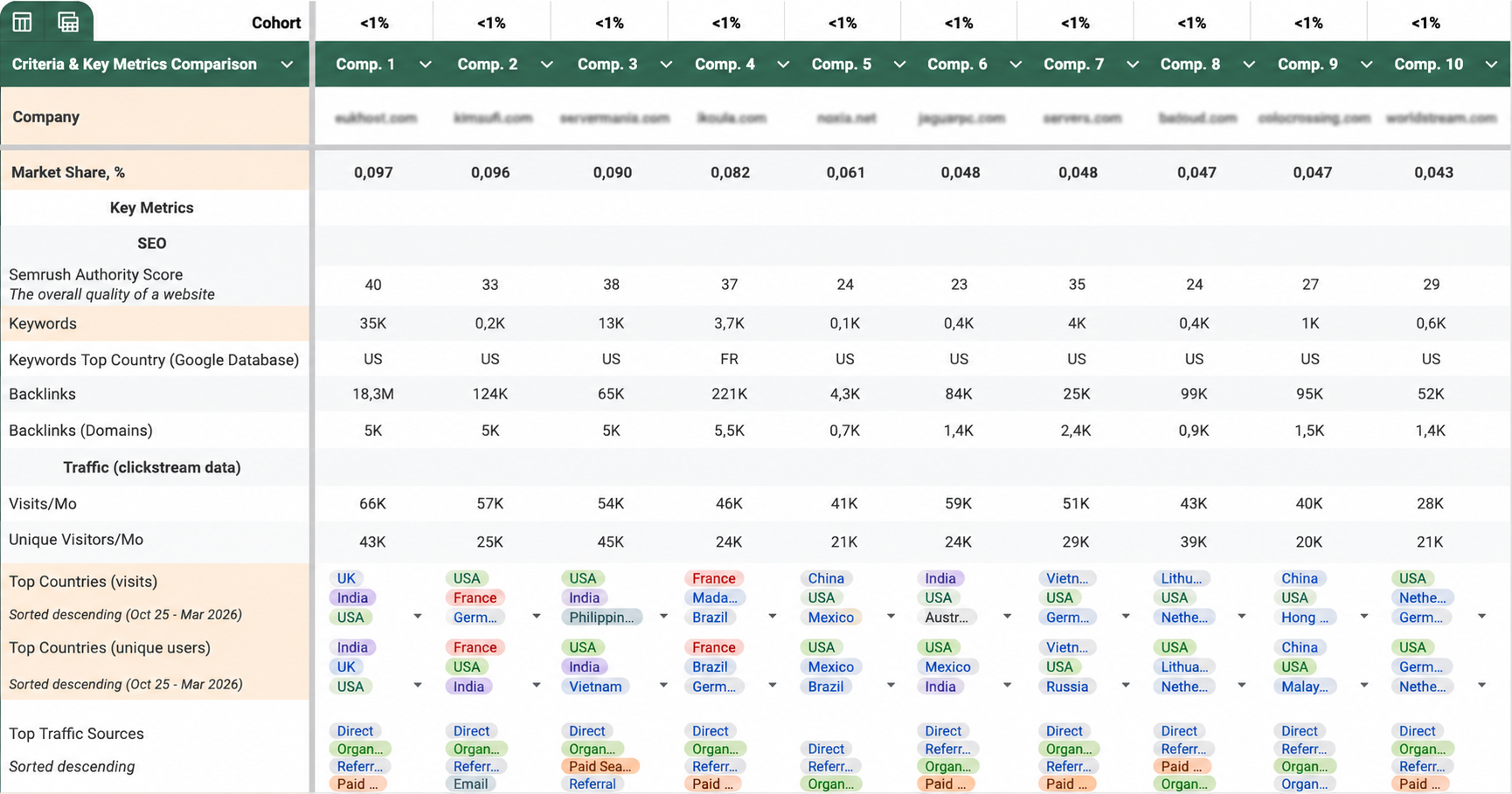
From Raw Data to Diamond Insights: The Actionable Blueprint
A master matrix filled with numbers is useless without translation. The diamond value of competitive intelligence lies entirely in converting raw numbers into surgical, high-impact tactical instructions for your product, content, and paid acquisition teams.
Let’s look at exactly how to translate observation into operational execution based on specific data patterns:
Slicing the Master Matrix:
Pattern A: Exposing the Under-Exploited Traffic Loop
The Raw Data Discovery: Your channel granularity analysis reveals that while the market leader dominates Google Paid Ads, they have completely ignored or downscaled their traffic presence in the Meta (Facebook/Instagram) or YouTube channels. Concurrently, a smaller, fast-growing direct rival is generating 25% of their high-converting traffic through an aggressive, targeted social retargeting loop.
The Strategic Insight: The market leader’s dominance has inflated Google Ads CPCs to unsustainable levels, creating a barrier to entry. However, the social channel remains an open territory with lower customer acquisition costs (CAC).
The Tactical Instruction: “Paid Media Team: Immediately halt further budget increases on high-CPC Google Search broad terms. Allocate 30% of our current ad budget to launch a high-velocity retargeting loop on Meta and YouTube. Emphasize our unique value proposition (e.g., speed and human support) targeting audiences that visit our landing pages but haven't converted.”
Pattern B: Operationalizing the Keyword Gap Matrix
The Raw Data Discovery: Your Keyword Gap tab reveals 45 long-tail, commercial-intent search terms (e.g., " cloud server for e-commerce," "fastest managed wordpress infrastructure") where two direct competitors are ranking on page 1, while your site has zero visibility. These keywords have a combined monthly volume of 15,000 searches and an average Keyword Difficulty (KD) below 40%.
The Strategic Insight: Competitors have mapped out clear content clusters that capture buyers during the active consideration phase of the purchase funnel, allowing them to acquire high-value leads organically without ad spend.
The Tactical Instruction: “Content & SEO Team: Pivot our content calendar for the next two quarters away from broad informational blog posts. Authorize the immediate production of a 5-part dedicated landing page cluster targeting these 45 missing commercial keywords. Ensure every page features an in-depth product comparison chart, clear technical specs, and a direct call-to-action for a free trial setup.”
Pattern C: Spotting the Regional Expansion Loop
The Raw Data Discovery: Your GEO distribution tracking shows a direct competitor’s traffic from a specific country (e.g., Germany or Ukraine) suddenly scaling from 5% to 22% of their total volume over a 90-day period. Ad intelligence tools reveal they have launched fully localized landing pages and are bidding heavily on localized search terms in that market.
The Strategic Insight: A competitor has validated a high-converting localized funnel and is actively scaling their acquisition infrastructure in a high-ARPU (Average Revenue Per User) geographic market.
The Tactical Instruction: “Product & Localization Team: We have a window of opportunity to counter-attack before their market share hardens. Accelerate our roadmap for localized German/Ukrainian billing interfaces and support documentation. Growth Marketing: Set up a dedicated, localized search campaign targeting their brand keywords in that specific region, offering a direct 20% 'migration discount' for users looking to switch platforms.”
Practical Case: Market & Competitor Deconstruction (Cohort & Traffic Slicing)
Data pulled from Similarweb, Ahrefs, or Semrush is nothing but chaotic noise until you slice it into cohorts and map it to a framework that drives predictable ROI. Stop bouncing between 20 browser tabs. The matrix below represents the core philosophy of Upart: Translating Raw Data into high-impact tactical instructions.
Below is a real-world ecosystem breakdown inspired by our recent digital infrastructure and hosting market audits. We took competing players, split them into strict market-share cohorts, isolated their structural vulnerabilities, and mapped out an immediate execution roadmap for both product and growth teams.
Criteria & Key Metrics | Market Leaders (Cohort >3% share) | Aggressive Challengers (Cohort 1-3% share) | Hidden Growth Hackers (Cohort <1% share) | Tactical Execution Roadmap (Our Diamond Insight) |
Dominant Acquisition Channel | Direct / Brand (60%+) Massive brand equity and user loyalty. High barrier to entry. | Organic Search (55%+) Aggressively burning budgets on high-scale SEO content factories. | Paid Search / PPC (45%+) Buying out transactional high-intent commercial traffic. | Competing in head-on SEO with Leaders is a cash-burn. Our focus: intercept the Hacker's PPC campaigns and hijack the Challenger's traffic gaps. |
GEO Market Distribution | Heavy focus on Tier-1 (US, UK). Local/regional markets are completely neglected. | Actively expanding into Western Europe (e.g., Germany - DE). Traffic growing +30% MoM. | Sneaking into untapped local markets (e.g., Ukraine - UA) with low-budget experiments. | Germany is red-ocean due to Challengers. The UA market has high local demand but weak SEO defenses among local players — we strike there first. |
Semantic Lacuna (Keyword Gap) | Ranking for high-volume, generic short-tail keywords. Completely ignoring long-tail. | Locked down major commercial clusters. Average Keyword Difficulty (KD) > 60. | Discovered narrow informational & transactional clusters with low KD (<35). | Extract the Hacker's exact semantic map. Reverse-engineer their top-10 traffic-driving articles by adding superior UX and deep data viz. Hijack their free traffic. |
Funnel & CRO Hooks | Rigid Enterprise checkout, friction-heavy flow with mandatory Sales team loops. | Pure self-service, aggressive discount pop-ups triggered on exit-intent. | Frictionless 7-day trial without credit card + highly gamified product onboarding. | Users are friction-fatigued by Leaders. We deploy a seamless self-service funnel, but weaponize it with the Hacker's friction-free trial model. |
Product & Offer Strategy | Traditional annual-only billing, strict lock-ins, zero refund flexibility. | "Switching Incentive": 30% discount for migration from competitors + free data transfer. | Aggressive Freemium model with tight, high-value usage limits inside the app. | Launch a sniper Brand Bidding campaign in Google Ads targeting the Challenger's brand keywords with an offer: "Tired of hidden limits? Switch to Upart — 2-hour free migration + first month on us." |
Take Action: Claim Your Master Analytics Sandbox
Stop scaling in the dark and guessing your next acquisition play. If you want to execute a ruthless, data-backed competitive audit that actually translates into high-impact tactical sprints, grab our operational framework.
Get Instant Access to the Google Sheets Competitor Matrix
Feel free to hit File -> Make a copy, load up your target URL list, and start reverse-engineering your industry's leaders before your next quarterly planning session.
Conclusion: Stop Guessing, Start Engineering Your Growth
Ultimately, market and competitive intelligence is the difference between operating a business on pure intuition and executing on raw, unassailable evidence. It shifts your internal conversation from «What should we try next?» to «Here is exactly where our market share is being stolen, and here is how we take it back.»
By treating your competitors as a highly funded research and development lab for your own growth strategy, you eliminate technical friction, cut out ad spend waste, and build a digital marketing infrastructure that scales predictably.
💬 Let's Unmask Your Niche: What's Your Biggest Data Blindspot?
Digging through raw competitor data can feel like being stranded in the desert without a map. Whether you are trying to calculate your true Share of Voice (SoV) against legacy giants or struggling to find the highest-converting landing page angles in your niche—stop guessing.
Drop your toughest competitive analytics challenges, market data gaps, or scaling questions in the comments below. >
Our growth team reads and analyzes every single response to help you reverse-engineer your rivals and find your next traffic loophole. Let’s build together!
Frequently Asked Questions
Software mentioned in this article
- Ahrefs
- Semrush
- 2026-trends
- Growth Marketing
- Marketing Strategy
- Business Growth
- market-intelligence
- competitive-strategy
- similarweb
- strategic-planning
- competitive intelligence
- competitor audit
- reverse-engineering
- keyword gap analysis
- traffic loops,
- rowth architecture
- digital analytics
- SaaS marketing strategy
- conversion rate optimization
- data-driven marketing
Post a comment
Comments
Recent News



Featured Software

David V.
6/18/2026Finally, a marketer who understands that monthly data checks on third-party intelligence platforms are just chaotic noise. Your point about using this as a quarterly baseline for strategic planning is spot on–it’s the only way to filter out short-term ad campaign spikes and see the actual structural shifts in Share of Voice
Viktoria
6/18/2026I liked that the article stays focused on execution instead of abstract theory. The breakdowns around traffic mix, keyword gaps, competitor funnels, and GEO expansion are actually useful for real-world workflows, not just for presentations. The tone is a bit intense at times, but the overall approach is solid: collect data, centralize it, and turn it into decisions.